Designing a Scalable AI Strategy for Enterprise Platform Modernization
Last Updated: 12/01/2025
Systems-level AI strategy
Enterprise governance awareness
Quality preservation under acceleration
Token architecture maturity
Parallel program execution capability
Design leadership beyond artifacts
The Quick Notes:
I helped design an AI-accelerated delivery model within a token-first design system to support the parallel modernization of 18 enterprise microapps from separate coed bases into a unified code base experience.
Rather than applying AI tactically, we embedded it into the delivery infrastructure through structured component contracts, edge-case libraries, and automated validation guardrails. Accessibility, analytics, and compliance were treated as release gates, not post-hoc fixes.
The result was a governed, scalable operating model that reduced design-to-code ambiguity, stabilized throughput across concurrent teams, and preserved quality under release pressure.
Project Artifacts
I helped identify this as a solution to our SDLC pipeline. I also created this video, script, and voiceover.
I helped develop this concept with the sales teams and client partners as an agentic solution for healthcare clients. I also created this video, script, and voiceover.
Executive Summary
I helped shape an AI-accelerated delivery model within a large-scale healthcare platform modernization spanning 18 microapps across web and mobile.
The initiative required:
Parallel delivery across multiple workstreams
Accessibility and analytics as release gates
Enterprise governance and integration constraints
Reduction of design-to-engineering rework
To stabilize execution under release pressure, I contributed to:
A token-first design system strategy
Structured design artifacts optimized for AI translation
Guardrail-driven AI workflows embedded into the SDLC
Cross-microapp consistency mechanisms
This was not about faster UI generation but rather about building a scalable delivery system.
The Context
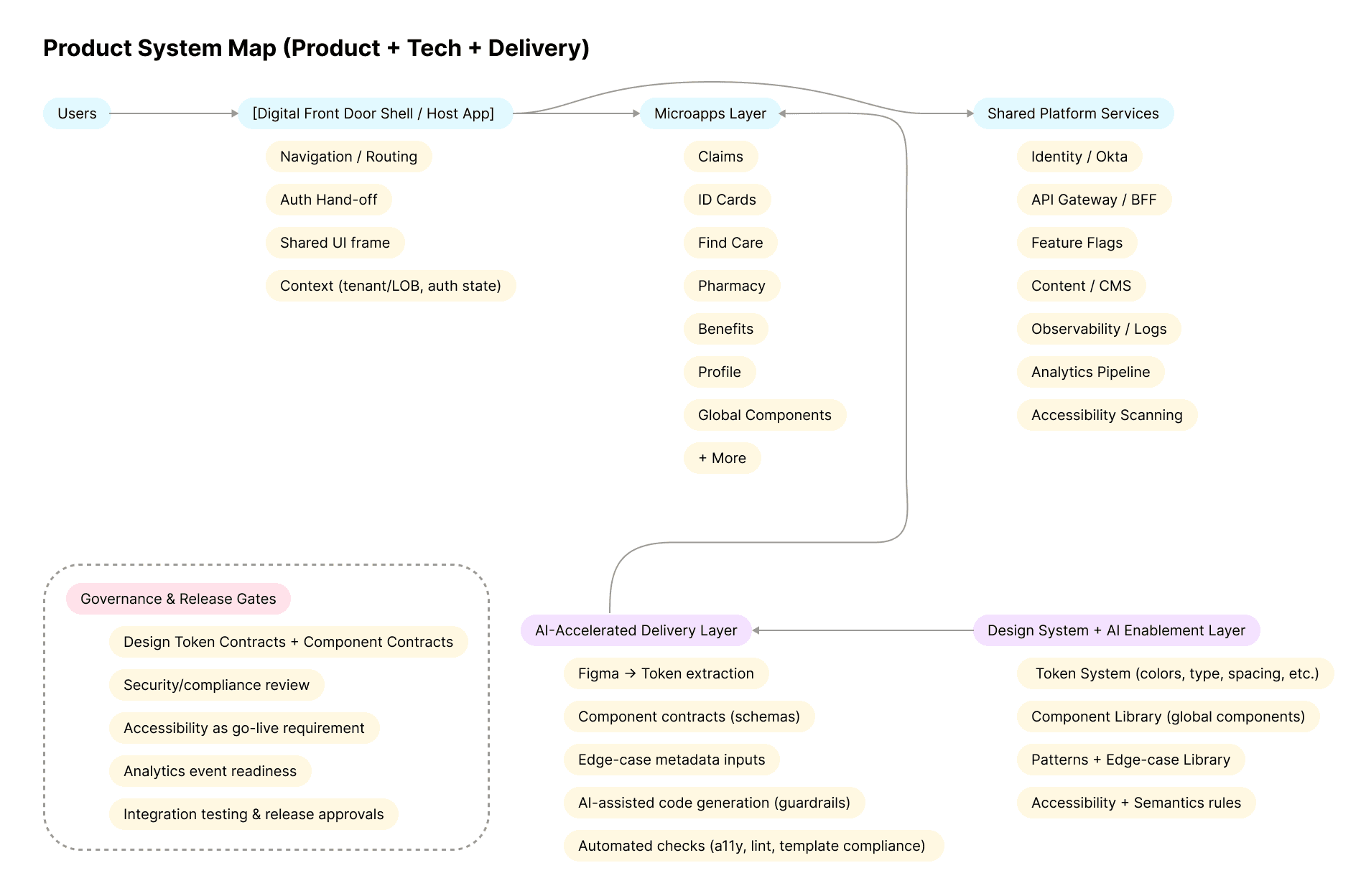
The organization was transforming its digital front door into a modular ecosystem including:
Claims
Spending Accounts
ID Cards
Find Care
Pharmacy
Benefits
Login & Registration
Profile
Dashboard
Global Components
At peak, 6+ microapps were in active development simultaneously with staggered release timelines.
Quality constraints included:
Accessibility compliance required for go-live
Analytics instrumentation as readiness criteria
Authentication and integration dependencies
High defect volume under triage
Traditional handoff models were not sustainable at this scale.
The Strategic Problem
As parallel microapps increased, so did:
Pattern fragmentation
Accessibility drift
Design-to-code inconsistencies
Review cycle inflation
Risk of compounded rework
The modernization required a system-level solution, not incremental improvements.
My Role
I operated across product design, design systems, and AI delivery strategy.
My focus areas:
Aligning token architecture to scalable reuse
Identifying AI intervention points in the lifecycle
Reducing interpretation layers between design and engineering
Supporting governance-aware automation
Stabilizing cross-stream throughput
Part I: Token-First Design System Strategy
I helped shape an AI-accelerated delivery model within a large-scale healthcare platform modernization spanning 18 microapps across web and mobile.
The initiative required:
Parallel delivery across multiple workstreams
Accessibility and analytics as release gates
Enterprise governance and integration constraints
Reduction of design-to-engineering rework
To stabilize execution under release pressure, I contributed to:
A token-first design system strategy
Structured design artifacts optimized for AI translation
Guardrail-driven AI workflows embedded into the SDLC
Cross-microapp consistency mechanisms
This was not about faster UI generation but rather about building a scalable delivery system.
To create a durable relationship between AI acceleration and our design system, we treated design artifacts as structured inputs rather than static visuals.
We established the following system constraints:
Each component included explicitly labeled variant states
States were named using a standardized taxonomy shared across teams
Design tokens were directly linked to accessibility and semantic requirements
Edge cases were tagged with metadata describing behavioral conditions
This allowed extraction scripts to convert Figma variants into structured, machine-readable inputs.
In practice, this meant AI generation operated against:
Declared component contracts
Enumerated edge states
Token-bound visual rules
Embedded accessibility constraints
Rather than asking AI to “interpret” designs, we reduced ambiguity by formalizing the interface between design and generation.
We intentionally reduced human interpretation layers by transforming visual design decisions into structured constraints that both humans and machines could reliably execute against.
Why Token-First
At enterprise scale, visual components are insufficient.
Tokens create:
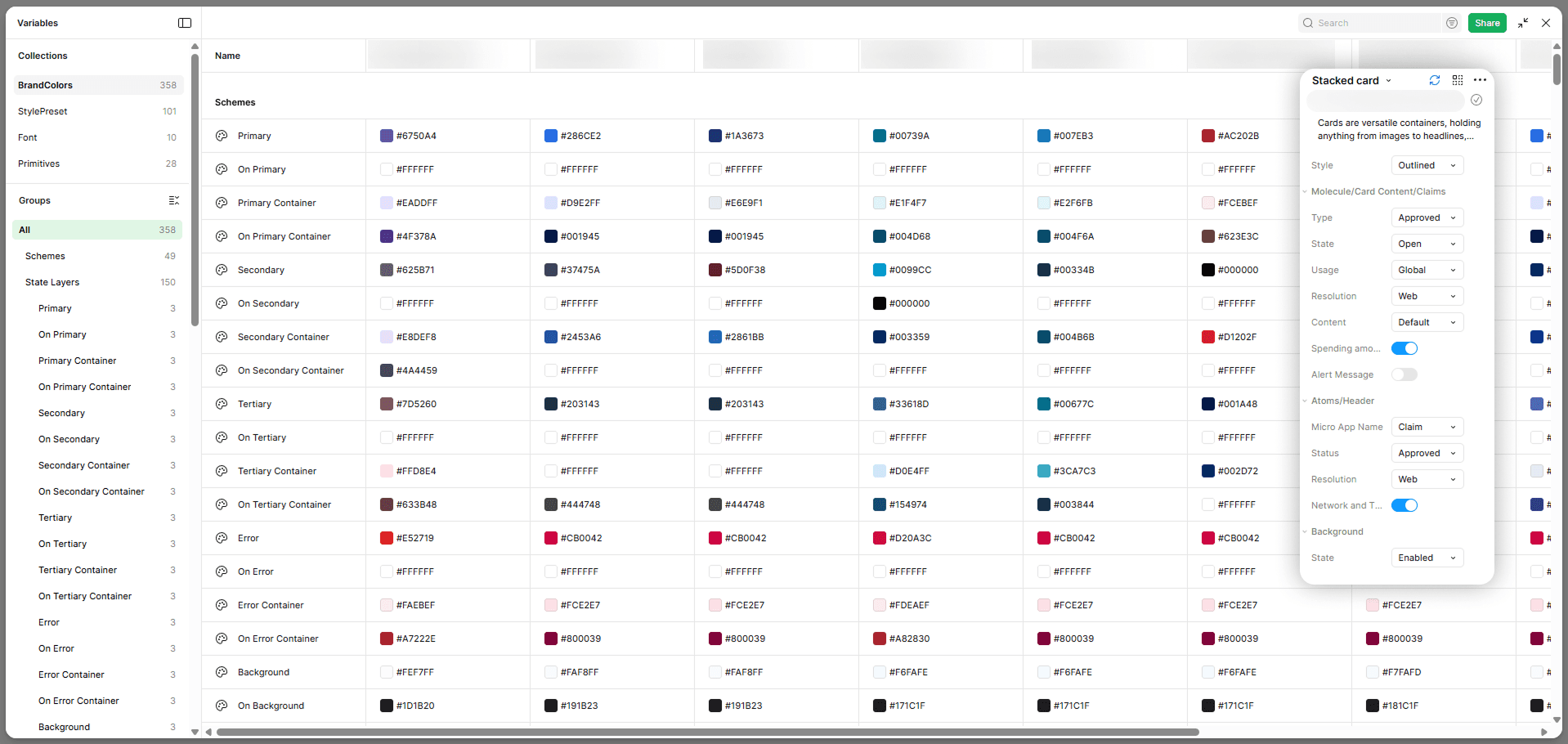
Machine-readable constraints (To support AI through MCP Server Code Pull)
Consistent theming across tenants
Cross-platform alignment
Reduced maintenance overhead
Structured inputs for automation
We shifted focus from UI kits to a token-driven system that could support:
White-label flexibility
Native-first cross-platform patterns
Global component reuse
Principle: Build global components once. Compose everywhere.
System-Level Impact
Tokenization enabled:
Reduced divergence across microapps
Faster propagation of updates
Improved accessibility consistency
Cleaner design-to-code mapping
It also created the foundation required for AI-assisted generation.
Part II: AI-Accelerated Delivery Model
Reframing AI as Infrastructure
AI was not positioned as a creative shortcut.
It was embedded into the delivery pipeline:
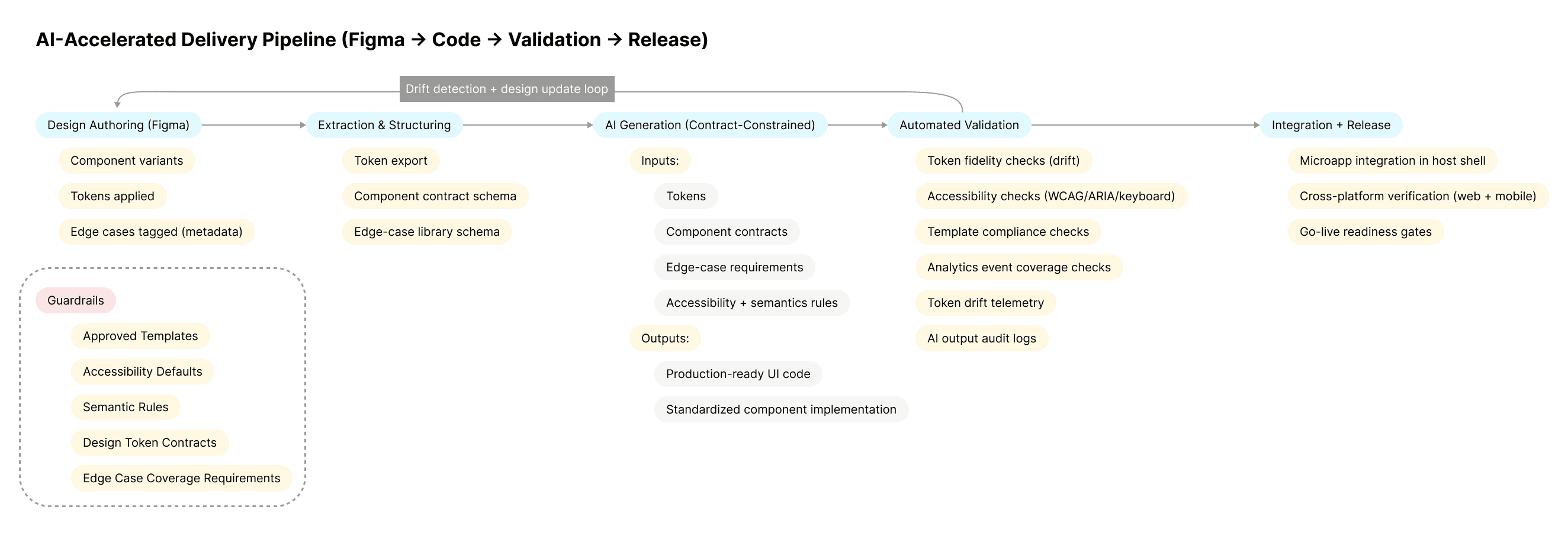
Figma → Tokens → Structured Spec → AI-Assisted Code → Automated Checks → Deployment
We identified friction points where AI could reduce translation loss:
Extracting tokens into structured formats
Generating standardized component code
Enforcing coding templates
Embedding accessibility defaults
Supporting PR-level checks
Guardrails Before Velocity
AI scale required constraints.
The strategy emphasized:
Token-bound generation
Accessibility baked into templates
Coding rules aligned to architecture
Consistent component contracts
Structured design inputs
AI operated inside defined boundaries.
This prevented acceleration of inconsistency.
Parallel Execution Stability
With 6+ microapps active, the objective was throughput stability.
AI-assisted workflows helped:
Reduce pixel drift
Decrease interpretation cycles
Improve implementation fidelity
Lower cross-team variability
Free senior designers to focus on edge cases
Under roadmap volatility and “At Risk” status, stability was more valuable than raw speed.
Quality Under Pressure: Accessibility Integration
Accessibility defect volume exceeded 400 issues during triage.
Instead of reactive fixes, we aligned:
Realignment of Contrast tokens
Semantic structure defaults
Keyboard navigation standards
ARIA-compliant patterns
Accessibility became embedded in generation constraints, not added during QA.
This shifted quality left in the lifecycle.
Quality Under Pressure: Accessibility Integration
Accessibility defect volume exceeded 400 issues during triage.
Instead of reactive fixes, we aligned:
Realignment of Contrast tokens
Semantic structure defaults
Keyboard navigation standards
ARIA-compliant patterns
Accessibility became embedded in generation constraints, not added during QA.
This shifted quality left in the lifecycle.
Quality Under Pressure: Accessibility Integration
Accessibility defect volume exceeded 400 issues during triage.
Instead of reactive fixes, we aligned:
Realignment of Contrast tokens
Semantic structure defaults
Keyboard navigation standards
ARIA-compliant patterns
Accessibility became embedded in generation constraints, not added during QA.
This shifted quality left in the lifecycle.
Designing for Real Platform Complexity
Each microapp had it's own unique list of challenges and complexities, from regulations, business decisions, project scope, and limitations.
Example: Find Care required-
Public and authenticated flows
Feature flag configuration
Tenant-specific logic
Container integration
Context-aware filtering
AI generation inputs helped account for structured context, not just visual design.
This ensured outputs aligned to platform realities.
Process Iteration and Improvement
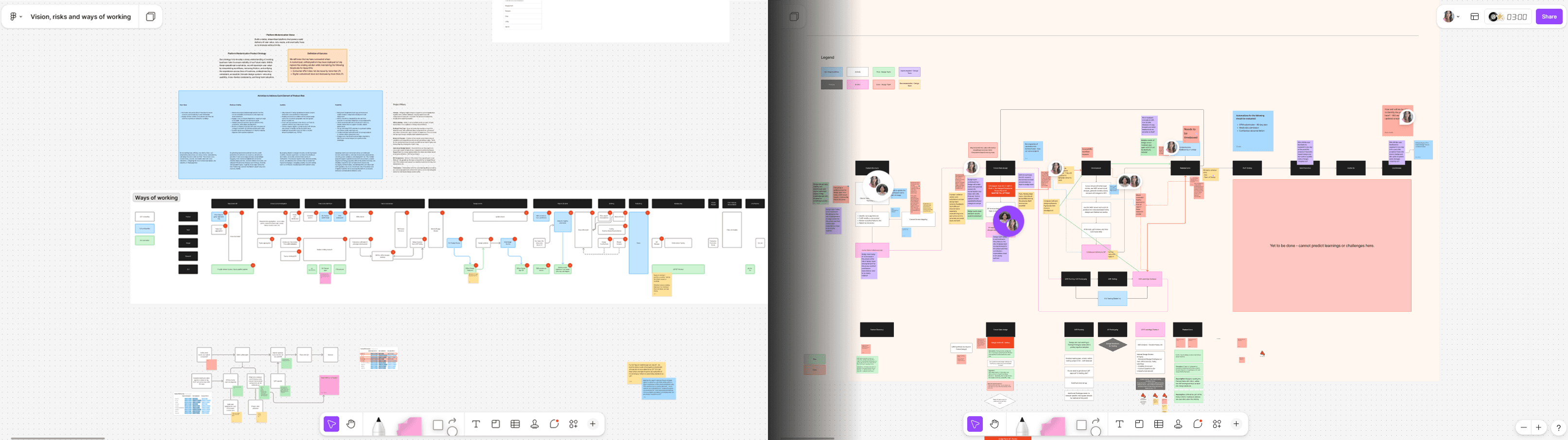
As the program evolved, we continuously refined the delivery operating model based on risk signals, accessibility defect trends, authentication blockers, and cross-microapp dependencies. The process itself was treated as a system subject to iteration.
Outcomes
Without exposing proprietary metrics:
18 microapps supported through staggered releases
6+ concurrent workstreams stabilized
Improved design-to-code fidelity
Reduced translation friction
Repeatable AI-assisted workflows established
Governance-aware automation integrated
Usability Metrics went from 43% to 95%
Most importantly:
We built mechanisms that scale under pressure.